CSCC logoMedical lab Technology

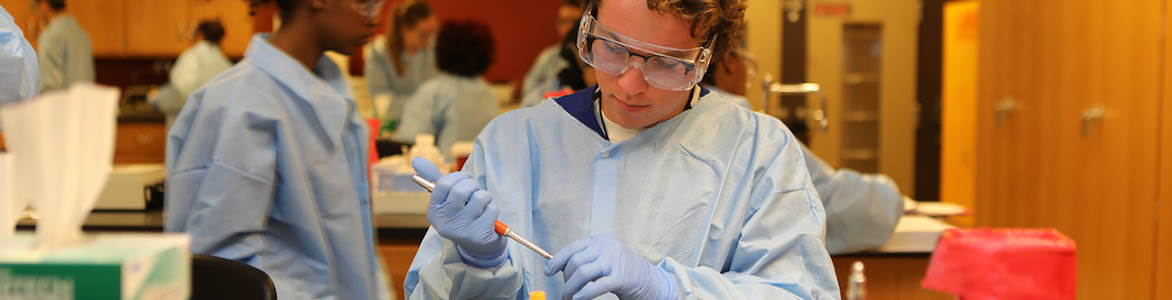
Requirements graphic
Program Requirements

Students enrolling in and graduating from a Medical Laboratory Technician program must meet the essential function requirements of the academic program and of the corresponding CLT/MLT profession with or without reasonable accommodations. They must complete programs consisting of academic study, simulated laboratory practice, and clinical laboratory experience. Students must be able to contribute to the progress of their peers, complete tasks assigned by instructors and clinical supervisors, and provide services that contribute to the well-being of patients. Columbus State will provide services and training, without discrimination, to academically qualified persons who meet the following essential requirements developed in compliance with the American with Disabilities Act (PL101-336) and the National Accrediting Agency for Clinical Laboratory Sciences (NAACLS):

Observation (Vision)

The MLT student must be able to:

  • Observe laboratory demonstrations of specimens, techniques, and instruments
     

  • Characterize the color, consistency, and clarity of biological specimens or reagents
     

  • Use a microscope to discriminate among find differences in structure and color (hue, shading and intensity) in microscopic specimens
     

  • Read and comprehend text, numbers, and graphs displayed in print and on a video monitor


Movement

The MLT student must be able to:
 

  • Move freely and safely about a laboratory
     

  • Perform moderately taxing continuous physical work, often requiring prolonged sitting or standing, over several hours
     

  • Travel to clinical laboratory sites for practical experience
     

  • Reach laboratory benchtops and shelves, patients lying in hospital bed or patients seated in specimen collection furniture
     

  • Maneuver phlebotomy and culture collection equipment to collect laboratory specimens from patients
     

  • Control laboratory equipment (pipettes, inoculating loops, test tubes) and adjust instruments to perform laboratory procedures
     

  • Use an electronic keyboard to operate laboratory instruments and calculate, record, evaluate, and transmit data


The MLT student must be able to:
 

  • Move freely and safely about a laboratory
     

  • Perform moderately taxing continuous physical work, often requiring prolonged sitting or standing, over several hours
     

  • Travel to clinical laboratory sites for practical experience
     

  • Reach laboratory benchtops and shelves, patients lying in hospital bed or patients seated in specimen collection furniture
     

  • Maneuver phlebotomy and culture collection equipment to collect laboratory specimens from patients
     

  • Control laboratory equipment (pipettes, inoculating loops, test tubes) and adjust instruments to perform laboratory procedures
     

  • Use an electronic keyboard to operate laboratory instruments and calculate, record, evaluate, and transmit data

Communication

The MLT student must be able to:

  • Read and comprehend technical and professional materials (textbooks, journal articles, handbooks, and procedure manuals)
     

  • Follow oral and/or written instructions in standard English in order to correctly perform laboratory test procedures
     

  • Clearly, effectively, confidentially, and sensitively converse with patients regarding laboratory test orders and specimen collection instructions
     

  • Communicate with instructors, peers, laboratory staff, and other health care professionals orally and in recorded format in standard English


Intellect

The MLT student must:

  • Possess the intellectual skills: comprehension, reasoning, integration, analysis, comparison, self-expression and self-analysis
     

  • Be able to exercise sufficient judgment to recognize errors and take appropriate corrective actions


Behavior

The MLT student must:

  • Be able to organize work and manage the use of time in order to complete technical tasks within realistic time limits
     

  • Possess the emotional health necessary to effectively use his or her intellect to exercise appropriate judgment in a distracting environment under stressful circumstances
     

  • Be flexible and creative and adapt to professional and technical change
     

  • Follow established safety procedures in order to minimize risk of injury to self and coworkers
     

  • Adapt to working with unpleasant biological specimens
     

  • Be supportive of peers and health care professionals in order to promote a team approach to learning, task completion, problems solving, and patient care 
     

  • Be honest and forthright about errors
     

  • Be able to critically evaluate his or her own performance, accept constructive criticism, and be responsible for improving performance
     

  • Be compassionate and ethical


ASCLS Essential Functions

If you are not certain that you will be able to meet these requirements, or know of anything that currently or in the future might affect your ability to fulfill these functions, please contact Disability Services to discuss your individual situation and/or request a specific accommodation.

© 2008 Columbus State Community College